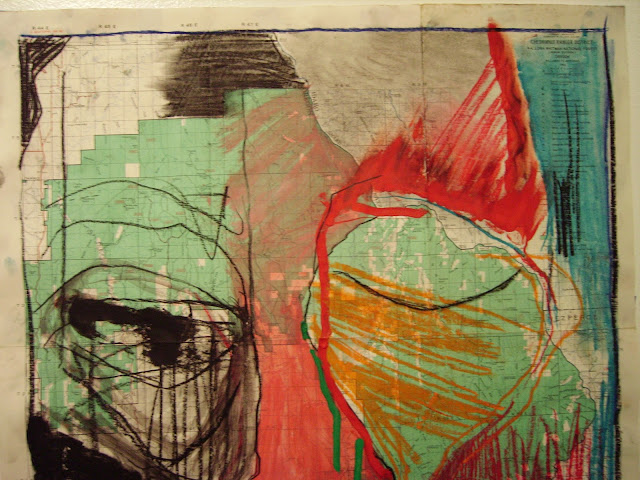
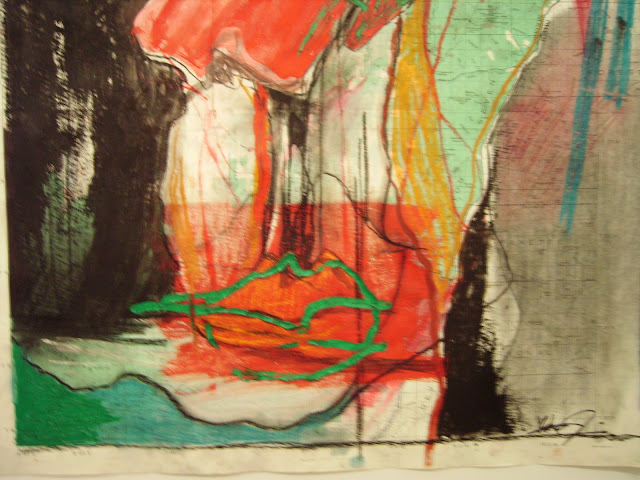
12.2.08
ON A FELLOW NAMED "BROOD", AND HIS DISRESPECTFUL TREATMENT OF FLOORMATS
So you know the place i speak of... It's mostly warm, sometimes dark, and inhabited by the annoying and sniveling man known as "Brood". Brood, right little motherfucker that he is, comes and goes as he pleases. He doesn't wipe his feet, and you can't decide whether to be excited about this or really bummed out about it. you don't know whether to have empathy for your welcome-mat or your carpet/wood-floor. and you don't know whether having the poor bastard's measly footprints all over your maple stomping ground is worse than having your welcome-mat read, "welcome home, sludge", when read as if it were one of those sentences formed by way of reading half words and half little pictures (they used to have those in those kids' magazines in the doctors' office and dentist office waiting rooms, and they used to have pictures of umbrellas and such. you would phonetically say the word that the picture brought to mind in conjunction with the letters and half-words and whole-words surrounding it. oh christ, what were they called? and dear god what was that magazine called?), or the other way around. do you like overtly-wordy sentences? i do.
Anyway, my point, which has devolved into something to which capitalization does not frequent, is something along the lines of this: you can choose whether Brood is a welcome guest or not, and frankly there aren't many times when he really should be (especially since it was he himself who thought he was welcome in the first place, and not you). Brood won't listen if you tell him nicely, so it is up to you and up to me to chuck whatever we can at him (socks, hairspray, violins, whatever) until he leaves. Also, you can lock the door to Brood, and they make these nifty things that you drill into your door that allow you to lurk whoever's knocking and either deem them worthy of entry or not. Lock your door, dudes, and if Brood knocks, tell him to take a hike and don't waste your good river-stick by giving it to him for a walking-stick.

ON THE ACT OF DREAMING
so the science of sleep kind of attempted to do this, but with more of a focus on the aspects of the dream world in reality and less of a focus on those aspects of reality that appear in dreams, and in what ways they do so...
my thought is this... do you know the feeling i speak of - the feeling had by the dreamer in the midst of a dream - which is as if the absolute relevance and significance of the dream (and of reality itself too) is figured out and understood? the dream contains events and interactions that are of a nature we might consider "odd" in real life, yet in the dream these odd elements are never questioned. there must be a reason behind this lack of need for questioning... perhaps the reason is that we are somehow aware more of the connection between events and fantasies (perhaps even the connection between people, as boundaries between individuals seem to be broken down in the dream world and affinities between multiple people are made quite clear), and this awareness of connection between different entities, ideas, emotions, and elements allows us to experience events that make perfect sense, taking into account these connections, whereas they would otherwise not. i really feel that, in every dream, i am aware of factors that make perfect sense and help explain things - big things - in a way that is both gripping and fascinating. nothing is mundane in my dreams. every tedious event has a larger significance, and every significant events is, although sometimes more obtuse or less shocking, equally important to the smaller events. i feel at ease in dreams, even those that frighten me or those which deal with difficult subject matter, because i experience a general sense of purpose, and every event seems to happen for a reason - each event is a little necessary part of a larger, linear puzzle - and i never doubt that the end conclusion and result of all the events and all my thoughts regarding these events will ultimately be revealed. herein lies the problem: i don't like waking up because it keeps me from solving the puzzle that seems so profound at the time of REM. furthermore, upon waking, the sense of purpose and fate and logical-connectedness-between-events is lost. things seem so much more up in the air and daunting and, often, less exciting in reality. but i feel that dreams are very much a part of reality. we spend 1/3 of our life dreaming. it makes sense to assume that the events in our dreams are, in some unconscious sense (and any of us who know anything about the psyche know that our unconscious mind has almost as much effect on our actions as our conscious mind, perhaps more.. i don't know) we are effected by the lessons learned in dreams, ideas composed in dreams, and events experienced in dreams. so the great mystery, which is the question of where our dream come from and from what source they are derived, is of great importance when this is taken into account. if dreams have a huge effect on our unconscious mind, and if our unconscious mind has a huge effect on our actions, then whatever puts the dreams into our heads has a lot of power over our actions. i like to think that, when i dream, i am somehow more connected to the entirety of my mind; perhaps even to the minds of others and hopefully to the soul of the world in general. i like to think that events in life will gain the significance and connectedness that events in dreams seem to have, and that the act of dreaming perhaps guides the dreamer by setting said dreamer's unconscious mind on the track that will help make the dreamer's life what it should be or what it can, gloriously, be. the fact that we understand so little about dreams is comforting to me. i think that which i consider to be the closest thing to god that i have ever experienced has been most present in my dreams, and i carry this sense of significance into my waking life when i have dreams that seem beautiful and profound. if all of us had beautiful dreams as we dozed, and if all of us were able to better understand them and able to remember the FEELING they were able give us, even after we awoke, perhaps we'd put more stock in reality and we'd aim to make life as exciting and open-ended and limitless as the dreamscape.
ON LIGHTHOUSE KEEPING
there was a little boy who lived with his grandfather by the sea. in the early mornings, the boy would wake and go to the shore of the ocean to watch the water rise and fall. he would wake early, just before the sun came up, so that he could be back in his room and pretend to have been in bed by the time his grandfather awoke and began to grind his coffee. each morning this happened, and each morning it was the same: the boy would rise, and he would sit and watch the ocean and sometimes draw animals in the sand with a piece of driftwood. each morning, he would walk back, and reach the door of his house, and shake the sand from his shoes next to his grandfather's fruit-tree orchard, and then he would tiptoe into the house, quietly open his door and close it, and sit in silence until he heard his grandfather stir.
it was in this time that he did those little things that eventually shaped him into the man he would become. sometimes he would open a notebook and draw the birds he had seen picking up scraps of sea-creatures from the rocks. sometimes he would close his eyes and imagine what sorts of shores lay further across the water. and sometimes he would open a book and read short stories of the kind that he most enjoyed: beasts, and demons, and bloodthirsty monsters, and the sorts of things that would freeze his clean blood cold and make him feel secure in the normalcy of warmth that he normally felt enclosed in, that was so far from that sort of cold. sometimes he would just lie in bed, and doze off for a minute or two before again waking, and between his lids and his eyes would flash images of things he had never seen yet suspected might exist, because the power of the ocean reminded him of the potential for power in all things in the world around him. because he was young, and because he hadn't seen much, he imagined that the world around him was stocked full of the most horrific things, and the most violent things, and also the most forgiving and beautiful and vibrant.
it wasn't that he was afraid of what his grandfather would say if he found out that the boy was making these walks to the ocean. it was that this - this watching of the sea - was something all his own, and he knew that if his grandfather knew about it, he would stop going: not because he would get in trouble, but because the sea wouldn't look the same to him.
his grandfather never asked him about the pile of sand by the roots of his fruit trees. the pile grew and grew until all that could be seen above it was the fruit itself. one walking past might assume, if having no understanding of such things, that apples and pears and peaches grew out of mountains of sand. and thus said passerby might come to assume that the sand in those parts, so near the ocean, contained nutrients more conducive to the birth of colorful fruits than any other kind of soil around. said passerby might assume that the sand had such power in it that the trees themselves would have no need for oxygen, for they were breathing in a magic that was more than any lung could ever hold.
when the rains came, the sand grew wet, and the boy went outside with a spoon and a rake and a shovel. he shaped the sand into a castle, and inside the castle were the fruit trees, their trunks freed and provided with air and yet enclosed in something majestic by nature and created by the boy's sense of wonder and that sense of wonder in and of itself. in this way, the materials needed for the building of a most beautiful kind of shelter came from none other than the boy's imagination and his inclination towards curiosity and his dedication to his own private and secret mode of passing his early morning hours.
NINJAS AND NOMADS
my fingers are ninjas, and they are nomads, and they are nimbly fighting the forces of numbness and ambivalence in the world one word, note, hug, and object picked up off the ground at a time. they clasped hands eagerly when i was just born, and they cried as they clasped. now they clasp objects, and stones from the riverbed (making room for other rocks to make their beds there), and invisible things snatched out of the sky and made to exist here on land. they trace patterns in the soil, and they dig trenches in the sand, and they form snow into little mounds and turn the snow into ice, melting it with the heat from within them and then allowing them to freeze harder in the winter airs yet to come. now, they reach around to touch things, and to touch the wind out of the windows of cars, and to touch instruments and make them less foreign, and to touch one-another in solemnity. now, they curl against my body as i sleep, and they stretch like yawning cats as i wake, and they drum against my palms to the songs that brew themselves in my head and die in my head, not needing to escape because they have lived for a second within the framework of my mind. we are soldiers, every one. and our weapons dance in our eyes, for they are our souls. and we shine like lighthouses across the bay and skip our lights out across the water to one-another so that we may bring the ships of other hearts to our shores for some time. we are noiseless beacons, and we grow ideas in our minds every day out of little seeds put there by the world around us, and these ideas grow larger, with many-a-limb, and they stretch their arms out and dig their roots down into our hearts. some of our ideas are secrets, and these are the elms by vacant shores that see the lights across the water and say, "i hear your silent siren call but i am here, and you are there, and i am content to be here on this beach alone." we are beaches, too, and the sands that lay atop us are each fragments of thoughts and memories and smells and tastes. none of these are ever totally gone, though they may dissolve into the swells of the ocean or they may be carried to other shores, or they may sink deep into the earth over thousands of years and melt in the core of it, for the earth, like our bodies, has flames in its heart, and it burns and melts that which enters there: not to destroy it, but to transform it. and the things that we let into our hearts are transformed if they catch word upon the wind of the temperature of our embers. we are burning up so that there may be heat around us, and we are hot to the touch so that our hearts may be treated with care, and our fires die down but this is a gift to the darkness, so that it may roam and, like the sun and like the fire, have its day too. if the fire in the earth dies down, as one day it might, it is to let the stars shine brighter: to let those things which are father away make their presence known. if the fire's embers wane, it is to let the moon reflect itself on our eyes and bounce back to the sky with a glow too small to recognize, but there nonetheless. if our hearts did not burn, there would be no snuffing, but their would also be no sense of relief found in the snuffing because there would be nothing to compare the silence and the darkness to. darkness, why the long face? you are a canvas on which the stars may be painted. darkness, why the frown? you are the river in which the planets may swim. darkness, why the fear? you are that which allows the lone wanderer to see the stars and find his way home to his own fire, in his own stove, by his own bed, under that tree that he watched grow as he watched himself grow. darkness, celebrate yourself for your own respectful withdrawl as you appreciate the light for its willingness to sleep. our hands cannot reach up and grab the light from the sky, but they can create the light themselves through the implementation of tools around them, and in this way they only hope to imitate the stars, at best, and in doing so to let the stars know that it is they who, amidst darkness, lead them home to that place where they may dig deep into wet soil and plant something there and watch it grow as they watch themselves, growing still.
once again i'm hearing the call of the fields and the call of the wanderer and the call of late winter nights. my feet cannot stay in one place, and the earth shifts below them. once again, i'm hearing the call of the stillness of those late hours in which all things shift as we sleep, in which minds turn themselves around like a sailor learning to jibe for the first time, and the seasons walk away and new ones walk up when we are not looking. winter taps one on the shoulder, and suddenly his presence is there, and the air is cold. he is bright, but he is dark. he is silent but every molecule of air is full in the space that he clears out before him. he is a rogue, and a wizard, and from his wand comes snow, and it greets only those mountains that grow tall enough to meet it as it falls. once again, too, to honor the notion of duality, i'm feeling the pull of the pressing-in, the weight of the cold as it pushes us back into our places and tells us that we need not roam because we are already where we belong. it is as if the cold is whispering to us, "this is my time, and these fields are my fields, and if you care to walk upon them you shall become as still as the frozen blades of grass around you." once again i am feeling the call of home, and bed, and memories; and i want to clear my mind of all that is my own and take in the words of writers long gone, and the words of the natural world around me, and the words of old folk singers from years long past, and the words of philosophers and scholars and chemists and gurus and hermits. i am feeling the call of the hermit, and yet i am feeling the song that only a group can sing because it contains such elaborate harmony. i am feeling the pull of the ocean even though i cannot see it, and the time is nearing when i will untie my little boat and push off from the rocks and set out into the sea and sail until i can see no land on any horizon. i crave the sanctity of vastness, and emptiness, and i crave the humbling laugh of the ocean and the tides. i crave the unknown, and the letting go and submitting to the forces that be: those that will take me to whatever shores they will. i crave adventure of a solitary sort, and perhaps i will tell stories of my internal wanderings or perhaps i will not. some things can only be shared with the wind, and the wind whispers secret things that are only shared with the soul and with no one else. the trees bow down toward the feet of the snow somewhere, in a place i've been but left, and the snow numbs the trees as they bow. the trees thank the snow for its freezing properties, and welcomes the cold embrace, for the embrace is one of such cold that the tree is allowed to sleep and rest and recharge in a way that it would not be capable of were it not for the snow's urging of stillness upon it.
once again i'm hearing the call of the fields and the call of the wanderer and the call of late winter nights. my feet cannot stay in one place, and the earth shifts below them. once again, i'm hearing the call of the stillness of those late hours in which all things shift as we sleep, in which minds turn themselves around like a sailor learning to jibe for the first time, and the seasons walk away and new ones walk up when we are not looking. winter taps one on the shoulder, and suddenly his presence is there, and the air is cold. he is bright, but he is dark. he is silent but every molecule of air is full in the space that he clears out before him. he is a rogue, and a wizard, and from his wand comes snow, and it greets only those mountains that grow tall enough to meet it as it falls. once again, too, to honor the notion of duality, i'm feeling the pull of the pressing-in, the weight of the cold as it pushes us back into our places and tells us that we need not roam because we are already where we belong. it is as if the cold is whispering to us, "this is my time, and these fields are my fields, and if you care to walk upon them you shall become as still as the frozen blades of grass around you." once again i am feeling the call of home, and bed, and memories; and i want to clear my mind of all that is my own and take in the words of writers long gone, and the words of the natural world around me, and the words of old folk singers from years long past, and the words of philosophers and scholars and chemists and gurus and hermits. i am feeling the call of the hermit, and yet i am feeling the song that only a group can sing because it contains such elaborate harmony. i am feeling the pull of the ocean even though i cannot see it, and the time is nearing when i will untie my little boat and push off from the rocks and set out into the sea and sail until i can see no land on any horizon. i crave the sanctity of vastness, and emptiness, and i crave the humbling laugh of the ocean and the tides. i crave the unknown, and the letting go and submitting to the forces that be: those that will take me to whatever shores they will. i crave adventure of a solitary sort, and perhaps i will tell stories of my internal wanderings or perhaps i will not. some things can only be shared with the wind, and the wind whispers secret things that are only shared with the soul and with no one else. the trees bow down toward the feet of the snow somewhere, in a place i've been but left, and the snow numbs the trees as they bow. the trees thank the snow for its freezing properties, and welcomes the cold embrace, for the embrace is one of such cold that the tree is allowed to sleep and rest and recharge in a way that it would not be capable of were it not for the snow's urging of stillness upon it.
ON FACETS OF THE SELF
we need to learn to anchor our hearts to our bodies, and our minds to our hearts, and our souls to our minds, and our hearts to our souls. we need to tackle problems that are bigger than our selves, because a mind working with another mind increases the chances of gaining some sort of understanding, exponentially. when i feel that whatever anchor in my own self has become caught on the rocks of my being, or when i feel that it has fallen off entirely and dropped to the sea-floor below, i look not back towards some part of my life in which i experienced comfort, for comfort is not there simply because it has passed. instead, i look back, prior to my own life, into the lives of others. into their symphonies, and their novels, and their essays, and their paintings, and their words and their stories. and i look at present outside of my own life. into other eyes, and other hearts, and other stories. tonight, i look to nietzsche. other nights, i look elsewhere. i look to any figure who reminds me that the essence of being human is something bigger than any one individual, and to fully understand the very ingredients of which we are made, we must look outside of ourselves. for evidence of what humanity is can be found within each of us, yet not one of us can entirely sum up any aspect of it on our own. i look to artists and musicians and writers and philosophers and thinkers, of the past and of the present, not to better understand my self but to fill in the blanks of understanding that i cannot find within myself -- understanding of humanity, and of passion and drive and inspiration. my soul is hungry for knowledge and experience and adventure, and even in knowing that this hunger will never be fed completely, i search on: not for a specific person or a specific sentence or a specific chord, but for the infinite slew of things that do nothing but feed the fire of my hunger to seek out more.
one of the pains of consciousness is the inability to discover and uncover everything that is there to be found. but the pain of not attempting to explore the world is an even greater breed of pain. and it is when we find something that makes all corners of our being - heart, mind, body, and soul - come together in some kind of harmony that we feel joy, and the memory of this joy causes us to seek out new discoveries and new worlds existing within other places and other people and other experiences. once one small intellectual or creative discovery has been truly made, the human being will not cease to crave more.
the downfall of innate curiosity and the soul's inclination to roam is the phenomenon of distraction. the self knows the pain of the delay in finding something that sparks something within the self, and it knows the pain of redundancy and regression. it knows the pain of loss, and the pain of things being ephemeral, and the pain of coming to know the exact proportions of the space between individuals; or the exact dimensions of the space existing between intention and output, or thought and expression, or love and portrayal of love, or sadness and tears, or joy and laughter. the fact that we cannot express anything in an entirely pure form is perhaps why some of us, needing so desperately to express the dances that occur within our souls, try so many mediums, and why we destroy our art or take back our words when they realize that they do no justice to what has happened within.
but the fact that we continue to attempt expression is our saving grace. and our failure to do so only encourages our souls to feel, in the hopes that they will feel something that cannot possibly be expressed in any way other than that which is entirely pure and perfect. if we are lucky, our lives will become our opuses, and our finest brush strokes will be that love which is conveyed in the purest and most impossible-to-doubt kind of way.
it is strange to me that the act of being born is, chemically, the act of becoming separated: separated from the mother and father (being parts of them that are removed from them and gain the ability to walk away from them and choose to accept or dismiss them), separated from the earth itself, and separated from others. one day each of us will return to the earth. our job while we are here is to feel, and to experience, and to translate these feelings in ways that are able to touch the souls of others and change them, and to translate these feelings in other ways that may exist beyond the lives of others. if each of us learns to create love, and convey love, and give love, then we will pass it to all of those around us, and to our children. equipped with love, and equipped with their own ability to create love, they will eventually pass a stronger kind of love on, and so on through the generations. we are afraid to do so because doing so, to all whom we know, means setting aside our desire to be separate entities, and doing so means being willing to become a part of everything around us, in ways that we will never know, and to lengths and degrees that we will never fathom.
one of the pains of consciousness is the inability to discover and uncover everything that is there to be found. but the pain of not attempting to explore the world is an even greater breed of pain. and it is when we find something that makes all corners of our being - heart, mind, body, and soul - come together in some kind of harmony that we feel joy, and the memory of this joy causes us to seek out new discoveries and new worlds existing within other places and other people and other experiences. once one small intellectual or creative discovery has been truly made, the human being will not cease to crave more.
the downfall of innate curiosity and the soul's inclination to roam is the phenomenon of distraction. the self knows the pain of the delay in finding something that sparks something within the self, and it knows the pain of redundancy and regression. it knows the pain of loss, and the pain of things being ephemeral, and the pain of coming to know the exact proportions of the space between individuals; or the exact dimensions of the space existing between intention and output, or thought and expression, or love and portrayal of love, or sadness and tears, or joy and laughter. the fact that we cannot express anything in an entirely pure form is perhaps why some of us, needing so desperately to express the dances that occur within our souls, try so many mediums, and why we destroy our art or take back our words when they realize that they do no justice to what has happened within.
but the fact that we continue to attempt expression is our saving grace. and our failure to do so only encourages our souls to feel, in the hopes that they will feel something that cannot possibly be expressed in any way other than that which is entirely pure and perfect. if we are lucky, our lives will become our opuses, and our finest brush strokes will be that love which is conveyed in the purest and most impossible-to-doubt kind of way.
it is strange to me that the act of being born is, chemically, the act of becoming separated: separated from the mother and father (being parts of them that are removed from them and gain the ability to walk away from them and choose to accept or dismiss them), separated from the earth itself, and separated from others. one day each of us will return to the earth. our job while we are here is to feel, and to experience, and to translate these feelings in ways that are able to touch the souls of others and change them, and to translate these feelings in other ways that may exist beyond the lives of others. if each of us learns to create love, and convey love, and give love, then we will pass it to all of those around us, and to our children. equipped with love, and equipped with their own ability to create love, they will eventually pass a stronger kind of love on, and so on through the generations. we are afraid to do so because doing so, to all whom we know, means setting aside our desire to be separate entities, and doing so means being willing to become a part of everything around us, in ways that we will never know, and to lengths and degrees that we will never fathom.
ON GATEWAYS
and right now it comes to mind that perhaps life contains rows and rows of haphazardly-placed gateways. the secret, maybe, lies in realizing that these gates are not there in order to be opened, for they are already open. energies so often spent trying to figure out how to open the gateways, or how to keep them from shutting, or how to leave through gateways already entered, are perhaps better applied to the act of simply walking through these gateways, and having the gall to walk through those that might be harder to squeeze through, or those that are so overgrown with vines and ivy and flowers that the enterer cannot see what lies beyond. the gates are already open, and they always have been, and they always will be. what exists beyond the gateways is entirely pliable in essence because that which exists beyond is entirely subject to the attitude and openness and willingness of the enterer. i've spent too much time thinking about what i fear could exist beyond certain openings, and i've spent too much time worrying about whether or not some of the gateways will slam shut and trap me inside. the truth, maybe, is that each gateway leads to a different portrayal of the same thing. maybe they all just lead to some large open field, and the pathways are interconnected beyond the creaking hinges of the entrances, and that which might be found on the other side is no better or worse when entered into by way of one gateway than it might be when entered into from another. the only wrong choice is to attempt to board up past gateways, for doing so is the equivalent of closing off entrances to places in which you already exist and always will exist, and thus forgetting the manner of the entering. doing so is the equivalent of deeming one path better than another. but who's to judge one tree-lined walkway with a cedar canopy as better than another tree-lined walkway bathed in the leaves of a liquid amber? every route is scenic, so let's enjoy whichever we take: the one nearest and thus most convenient, or the one seemingly most terrifying due to its exceptional darkness, or the one most colorful, or the one towards which the wind seems to blow us. all that is required or asked of us is that we walk, dance, skip, jump, and move our feet; and that we remain open to awe and conscious and contemplative and appropriately respectful as we make our journeys. my path will cross other paths and it will even cross paths that i've already been on, and the wanderer who has traveled for years is no more legitimate than the wanderer who has traveled for only a day or two, for each wanderer might end up in the same clearing at some point, or see the same creatures stroll by and skit away into the brush, and each wanderer is equipped with different rations of food and different amounts of water and different walking-companions and different fondnesses for different paths of the past. and this is how we grow from one-another, and this is how the forests and woods grow around us and alter us permanently in a fluid and ever-shifting way.
let us grow like the trees: up towards the changing sky; accommodating to different feathered beings that might take shelter in our branches; adaptable to the loss of limbs from time-to-time; planted firmly in a soil whose nutrients are not of our own making, but the making of everything else around us; permitting the heavy blows of the wind, and the ax, and the falling limbs of other trees; stooping under the weight of rougher years and reaching again for the sky when we have found a balance amongst our branches that enables us to once again stretch out toward the stars; unsure of what exists above us in the place toward which we grow, but eager to grow on just in case we might find something there that changes the colors of our leaves. and nothing that we grow toward will be regrettable, for it will become a part of us and nourish us, and if it knocks us down or sets fire to our roots, we will either be resilient and overcome such flames, or others will grow stronger due to the light that our inflamed trunks allows to reach the rest of the forest due to the space cleared in the sky by the absence of once-existing limbs that had once blocked out rays of sun from other trees. the individual trees themselves may not be old, but they are all a part of something older than any one part of it: a network of underground root systems that is far more intricate than any one tree will ever be able to comprehend. in this way, the most gnarled tree can be the most beautiful, or the most timid birch can be the most bold, and nothing will ever be the same as it was the day before because no day goes by without some other entity changing or altering the network beneath the earth that stretches for inches, feet, or maybe miles toward the hot core at the heart of the planet.
let us grow like the trees: up towards the changing sky; accommodating to different feathered beings that might take shelter in our branches; adaptable to the loss of limbs from time-to-time; planted firmly in a soil whose nutrients are not of our own making, but the making of everything else around us; permitting the heavy blows of the wind, and the ax, and the falling limbs of other trees; stooping under the weight of rougher years and reaching again for the sky when we have found a balance amongst our branches that enables us to once again stretch out toward the stars; unsure of what exists above us in the place toward which we grow, but eager to grow on just in case we might find something there that changes the colors of our leaves. and nothing that we grow toward will be regrettable, for it will become a part of us and nourish us, and if it knocks us down or sets fire to our roots, we will either be resilient and overcome such flames, or others will grow stronger due to the light that our inflamed trunks allows to reach the rest of the forest due to the space cleared in the sky by the absence of once-existing limbs that had once blocked out rays of sun from other trees. the individual trees themselves may not be old, but they are all a part of something older than any one part of it: a network of underground root systems that is far more intricate than any one tree will ever be able to comprehend. in this way, the most gnarled tree can be the most beautiful, or the most timid birch can be the most bold, and nothing will ever be the same as it was the day before because no day goes by without some other entity changing or altering the network beneath the earth that stretches for inches, feet, or maybe miles toward the hot core at the heart of the planet.
ON KINDS OF LOVE
every kind of love is valid, and every kind of love exists forever in some manner or other, even if just in its occupation of the realm of memory. the sort of love that can be translated by way of music is a particularly beautiful kind.
it may seem on the surface that human beings have, to a large extent, forgotten how to love. this might be the conclusion that one would reach after a half-assed observation of the species. but i'd like to assert that humans are perhaps just as capable of loving as they have ever been. the problem is simply that each person encounters so many people, of so many different kinds, and experiences so many different breeds of love, and thus doesn't know what to do with the floods of love that come to the heart. love is too often stifled because so much time is spent worrying about how one kind of love will affect other kinds of love, and how one kind of love will affect another person.
the answer seems not to be anything resembling the "free-love" movement of the sixties. rather, it seems to be this: consciously attempting to acknowledge, give, recognize, and experience love of all kinds, and exercising honesty in all realms as a necessary accomplice to love itself. i'm not condoning having multiple relationships of a romantic or sexual nature at the same time. i'm condoning loving people in platonic or brotherly ways and recognizing friendship and acquaintanceship and brotherhood and the like as valid forms of love.
people seem to be lonely so often because they forget that the love that comes to them from friends and family are just as important and real and nurturing as the love that hits like a stampede and lights the soul on fire as it runs around burning and crying out. the latter is a primal need, and the former is no subsitute for it, but the former is just as important in other ways.
(September 2007)
it may seem on the surface that human beings have, to a large extent, forgotten how to love. this might be the conclusion that one would reach after a half-assed observation of the species. but i'd like to assert that humans are perhaps just as capable of loving as they have ever been. the problem is simply that each person encounters so many people, of so many different kinds, and experiences so many different breeds of love, and thus doesn't know what to do with the floods of love that come to the heart. love is too often stifled because so much time is spent worrying about how one kind of love will affect other kinds of love, and how one kind of love will affect another person.
the answer seems not to be anything resembling the "free-love" movement of the sixties. rather, it seems to be this: consciously attempting to acknowledge, give, recognize, and experience love of all kinds, and exercising honesty in all realms as a necessary accomplice to love itself. i'm not condoning having multiple relationships of a romantic or sexual nature at the same time. i'm condoning loving people in platonic or brotherly ways and recognizing friendship and acquaintanceship and brotherhood and the like as valid forms of love.
people seem to be lonely so often because they forget that the love that comes to them from friends and family are just as important and real and nurturing as the love that hits like a stampede and lights the soul on fire as it runs around burning and crying out. the latter is a primal need, and the former is no subsitute for it, but the former is just as important in other ways.
(September 2007)
ON TIME SPENT ALONE
My own realizations shock me sometimes. The topic that my thoughts always come back to is the topic of solitude, not in a general sense but with respect to its importance as a catalyst for creative endeavors. I know that there exists some kind of a balance between interaction with others and solitude, and I know that both are equally essential in their own right for the creative individual, but something about the former leaves me nauseous at times, and longing for time alone, and this longing for time alone is a thinly-veiled longing for creative output and intellectual input. Interactions with others leave me hungry for something, and this something makes itself known in a fierce way that keeps me up at night stressing over nothing in particular, but everything at once.
Does being a creative individual (and i mean this in a broad sense that encapsulates all mediums and art forms and that counts intellectual pursuits as creative pursuits, for the soul of the artist and the soul of the intellectual are, in my opinion, necessarily inseparable) require a degree of self-loathing in order for the creator to be productive? If I find myself in a place where I feel too much comfort, I begin to despise myself, for in this comfort I am not driven to write, and I am not driven to learn, or compete, or to make music, or to move forward in the career world with the kind of passion that I want to possess. I crave this kind of unsettledness, and I crave this sense of urgency. I crave this sense of "something is not right" and "something needs to be done". for this is the drive that causes me to create, and to write' and this is the drive that gives birth to passion in the soul. I feel more lost when I do not feel this drive, for when I feel content, I forget where I am on the path of my life, and where I am becomes more of a point surrounded by nothingness than a specific point on a line, or a ray, that links my past to my future. I cannot exist as a point, no matter how euphoric the nature of that point is. Rather, I need to exist as a ray, constantly looking toward the future and, somehow, constantly fearful of the future (although not in a way that overwhelms me and renders me stagnant). I need to exist as a ray pointing toward the future, fearful of the future in a way that makes me constantly aware of the importance of doing those things about which I am passionate. I cannot exist in a way that allows me to forget about my reasons for educating myself and writing and making music. I need to constantly, or at least sporadically, feel ill at ease and uncomfortable, for in this uncomfortableness I am reminded of the need to push on, and continuously work on things, and continuously search within my own mind for truth, and continuously create. I need to constantly or sporadically hate where I stand with regard to myself and my peers, so that I constantly feel inclined to work harder. I must keep doing this in order to feel happy, even whilst knowing that I will never reach a point at which I will feel proud of my work, or satisfied with my work; at least not for long. It is strange that the artistic and intellectual drive is such: Even while fully aware that that which is created will never be satisfactory for the individual who creates it, the individual himself cannot help but continue to try to make something that satisfies his own judgment. Logically he is aware that this is impossible, yet he fools himself into thinking that he could be wrong, and subsequently presses on again and again, always dissatisfied, and always eager to try to make something better, or to do more, or to work harder, not because he thinks he can ever be content (for he does not want to be content: as an artist, contentedness is the equivalent of death), but because he hates himself when he is not working, and because he loathes his past creations, and only in working does he feel he is moving beyond this level of productivity and quality that he so despises. In seeing end products of new projects, he does not find contentedness or peace of mind. Only in the act of working itself does he find any sort of solace or quietude of his inner-voice.
The artist and the intellectual know this, and if they are one and the same they know this all too well. This individual, an embodiment of the mind and the soul and the heart, and the desire of all three to break free from something that they know they are forever trapped inside (perhaps this thing is he body itself), is fully aware of the futility of all of his efforts, not in the minds of others but in his own mind, for he will never create something that will render him content enough to cease his efforts. He is aware of this, yet he continues, for he knows that not attempting is worse than seeing a series of failed attempts forever until his death, and he cannot bear not to attempt to defy the limitations of his own body and mind any more than he can bear not to sleep or eat. In fact, sleeping and eating sometimes come secondary to the artistic drive.
The artist/intellectual has within his soul an infinite well of creative energy, despite his body's finite supply of physical energy, and the two are constantly at odds. The individual hates these limitations. Just as art in general is perhaps an attempt to defy one's own mortality, the daily acts of creation and thought and analysis are each respective attempts at defying the body's own needs for rest and sleep and quietude. In this day and age, these acts become not only attempts to defy the body, but attempts to defy the structure of society, and the conventions of how one is supposed to live.
The artist reflects upon the large machine that is the economy, the political world, the media, the world of pop culture, and collective conscious, the world of science, and the world of religion, and the world of technology (and so on in this fashion) in such a way that is unpleasant in the eyes of that which it depicts. It shows a side of things that are perhaps otherwise hidden, and it often shows a negative side of things. This is as necessary for the advancement of the sciences and culture as institutions themselves, but despite the necessity of such a process, it is hated by those who see themselves reflected as a result of the process. The artist and the intellectual fight each day for survival, emotionally and physically, and constantly run the risk of being exterminated. The artist and the intellectual must fight many fights: the fight to stay alive and afford to eat (a fight imposed by the difficulty of finding work and simultaneously making art), the fight against the monotony of the job required in order to do so, the fight against the inner-critic and his hatred of the self, and his hatred of the self's work, and his hatred of the self's lack of productivity (often due to previously mentioned job and the need for such in order to survive), the fight against the rest of society's persecution. Much of society hates the artist and hates the intellectual, for he represents something uncomfortable (which makes sense, for his very existence is the result of discomfort and the tendency to create this discomfort for himself on purpose), and also because the artist and the intellectual expose to the rest of the world truths about their own nature that they themselves where unable to see for themselves. This is the ultimate slap in the fact, for it shows those who are content to be stagnant and comfortable that they should not necessarily be so content to be as they are.
ON FIGURATIVE SUNLIGHT
why do i see people with the sun in their eyes become so saddened by the world around them? it's because they have the sun in their eyes. but it's these people, who know the sun is in their eyes and yet refuse to look away, that end up knowing the sun and its magnificence better than those who don't bother to look, or those who look for a second and then look away once they realize how much it hurts, or those who look into it and refuse to really see it for what it is, or those who let themselves be blinded by it and refuse to believe that anyone else can see any of it for more than a split second because they, due to their blindness, no longer can. i've known all of these people and it is those who look into it yet refuse to be blinded by it - those who look into it and refuse to look away - that come to truly know the beauty of their world and the meaning of their world in the most astounding way. once they get used to the glare i know that they'll forget how much it can hurt and they'll dance with the others who have sun in their eyes, too. once they look at it they know there is no looking away and they know that there's no going back. perhaps they could go back if it weren't for the fact that they know that doing so is foolish and silly. but they do know this fact. and they won't look away. and it's these people who realize that they were born with the same sunlight running through their blood and immersed in their words and seeping out of every piece of the world around them.
and if they look away, they'll remember what they saw, and maybe the loss of that will pain them until they look into it again. and if they are blinded by it, maybe the last image of what they have seen will be enough to sustain them even if things seem dark. and if they refuse to look, maybe they will gaze in awe and wonder at those who are bold enough to do so, and maybe this wonder and awe will sustain them and the knowledge of something better will keep them moving until they have the courage to try to look themselves.
but what it boils down to is the truth in the following: i have faith in those people who have faith in other people, and who have faith in themselves and in the potential of human interaction and in patience and in effort. i've lost lots of pieces of sunlight in my time and i know that they're never really gone, and they're never really snuffed. and the light that's left to absorb is infinite and can make that which is lost, in time, fondly remembered due to its ability to remind the self of the inifinitude of that which is left to experience.
(February 2007)
(February 2007)
ON THE CONCEPT OF HOME
i have been thinking of home these days. when i find pieces of things that feel like home, i think of it. home is such a transferable concept. it seems to be something mostly kept close to the self, lodged somewhere inside the psyche, known better than one's own self and loved more than one's own kin. my home exists somewhere between here and nevada city, although not in any actual town or field between the two. it exists more in a place between the two, written on a scale of importance. it exists in the connections i form between the life of my past and the life in which i now live; the life of my future, too. it's not a melancholy feeling, because it's not something i necessarily want to pin down. more so, it is a feeling of excitement. i hold onto things of the past like relics that i observe but do not touch. their place in the layout of my life shifts with each new experience. something once deemed of utmost importance takes a seat behind something new, and then that something new ultimately takes its seat behind the old if it proves to be less significant. the present always takes the front seat, by default, like a cocky child, because the present is unlimited and therefore, in the imagination, it is infinite and it is infinitely greater than anything prior to it. i hold onto the future like a thing that is almost tangible, yet in a way that i cannot yet observe. it seems that the self is so eager to ascribe this feeling of "heimweh" (home-like) to everything it encounters, that home becomes a colorful jumble in which there exists some carefully orchestrated yet fluid balance between the ever-present and the ever-elusive. the elusive is viewed as something familiar: something totally definable and totally discernible. this is because of the very fact that it is elusive. its elusiveness renders it infinitely powerful and important.
point being, i've not been sleeping much lately because my mind has been trying to process what it has known, and subsequently trying to counter this with what it realizes it cannot know, and lastly with what it may one day come to know. i'm okay with it.
(January 2007)
(January 2007)
ON SOMETHING AND NOTHING
I look around at others who are my age, and I know that any one of them might be able to say, “I don’t know what I want”, and truly, completely mean it; but something feels amiss in my psyche, in a way that transcends the meaning of that simple youthful utterance. I know what I don’t want, and I know how to turn any thing into exactly that, so that I might want nothing; and so it is not that I don’t know what I want, but rather it is that I want nothing, and I want one thing to exactly the same degree (or lack thereof) as another. But I find nothing itself to be, by definition, quite boring. Herein lies the dilemma: I cannot just choose, out of all the “gifts” of life, nothing. Why not? Well, due to an absolute and penetrating fear of being incorrect about something’s apparent “nothingness”. What if I were to write something off as nothing without realizing that it is, in fact, something; that it does, in fact, have some value? Can there be a thing that seems completely devoid of value and worth upon first examination, but possessing difficult-to-find qualities that, in the magnitude of their something-ness make up for the overwhelmingly nothing-like quality of the things observed upon first examination?
It seems impossible to be sure that something is entirely nothing without fully examining it, as unappealing as the prospect of examination might at first seem, due to the subject’s boring nature. However, it seems necessary, for peace of mind and for the sake of making sure that nothing in the world is neglected in this search for somethingness in the world around me. Thus, it seems that the only thing to do is to, piece by piece, look carefully at everything around me, and take care to strive to know the complete essence of every single thing, so as to not miss any scrap of somethingness that might exist therein. The question, then, has to do with the order of operations involving this examination process. Where does one begin? Does one choose to first look for somethingness in whatever thing seems most likely to possess somethingness? If so, how is this determined? Does one choose to first look for somethingness in everything at once? If so, how can this be done thoroughly?
Let us say, for the sake of discussion, that we find the one-at-a-time method of examination most useful and appropriate in this tiresome search for somethingness. But where does one begin? But which nothing is better than any other nothing? It seems my only option here is to continuously choose one nothing, try it on, hope that it might surprise me and turn itself into some kind of something, and then wear it for eternity if it does and discard it if it doesn’t. If it fails to prove to me that it is any kind of something, I will repeat the process, until death if I have to.
Amidst this cycle of hope and disappointment (the latter appearing in the disgusting form of boredom itself), there is one salvation and one solution to complete idleness and monotony: The imagination. The imagination has this amazing power of fixating on things whose beings are not entirely known, and doing two things: 1) choosing to ignore those qualities or characteristics that are displeasing and exemplary of the nothingness within the thing, 2) glorifying those qualities or characteristics that are pleasing in any way at all, even if only due to the act of following number one, and 3) imagining any number of even more glorious characteristics that might be attributed to the thing, until an awareness of the thing’s entire being is present within the imagination. This awareness is based on only a tiny percentage of truth, and the majority of it is the result of imagination, but it is a phenomenon that leads me to suspect the following: The more active and powerful the imagination, the more dissatisfied the individual will be with the reality of situations; because the individual who is able to imagine something to be glorious will be that much more let down when he finds his imaginings to be ungrounded in reality altogether.
Nothingness is not the absence of everything, but rather equal degrees of everything (and thus nothing spectacular). Nothingness is not the absence of anything interesting, but rather the absence of that which I sense is possible in individuals: the essential, vital, urgent, quality that is the only thing providing me with any hope for humanity or any desire to continue to investigate the world around me.
I search for something more than this nothingness because I sense it exists. It seems that one does not look for something that he doesn’t think exists. For example, would someone look for car keys if they never had car keys? Presumably not. Would someone look for a killer if someone is not killed? Presumably not. Similarly, would someone look for something-ness if there was not need for it, or evidence of it, or a use for it, or a necessity for it?
It seems impossible to be sure that something is entirely nothing without fully examining it, as unappealing as the prospect of examination might at first seem, due to the subject’s boring nature. However, it seems necessary, for peace of mind and for the sake of making sure that nothing in the world is neglected in this search for somethingness in the world around me. Thus, it seems that the only thing to do is to, piece by piece, look carefully at everything around me, and take care to strive to know the complete essence of every single thing, so as to not miss any scrap of somethingness that might exist therein. The question, then, has to do with the order of operations involving this examination process. Where does one begin? Does one choose to first look for somethingness in whatever thing seems most likely to possess somethingness? If so, how is this determined? Does one choose to first look for somethingness in everything at once? If so, how can this be done thoroughly?
Let us say, for the sake of discussion, that we find the one-at-a-time method of examination most useful and appropriate in this tiresome search for somethingness. But where does one begin? But which nothing is better than any other nothing? It seems my only option here is to continuously choose one nothing, try it on, hope that it might surprise me and turn itself into some kind of something, and then wear it for eternity if it does and discard it if it doesn’t. If it fails to prove to me that it is any kind of something, I will repeat the process, until death if I have to.
Amidst this cycle of hope and disappointment (the latter appearing in the disgusting form of boredom itself), there is one salvation and one solution to complete idleness and monotony: The imagination. The imagination has this amazing power of fixating on things whose beings are not entirely known, and doing two things: 1) choosing to ignore those qualities or characteristics that are displeasing and exemplary of the nothingness within the thing, 2) glorifying those qualities or characteristics that are pleasing in any way at all, even if only due to the act of following number one, and 3) imagining any number of even more glorious characteristics that might be attributed to the thing, until an awareness of the thing’s entire being is present within the imagination. This awareness is based on only a tiny percentage of truth, and the majority of it is the result of imagination, but it is a phenomenon that leads me to suspect the following: The more active and powerful the imagination, the more dissatisfied the individual will be with the reality of situations; because the individual who is able to imagine something to be glorious will be that much more let down when he finds his imaginings to be ungrounded in reality altogether.
Nothingness is not the absence of everything, but rather equal degrees of everything (and thus nothing spectacular). Nothingness is not the absence of anything interesting, but rather the absence of that which I sense is possible in individuals: the essential, vital, urgent, quality that is the only thing providing me with any hope for humanity or any desire to continue to investigate the world around me.
I search for something more than this nothingness because I sense it exists. It seems that one does not look for something that he doesn’t think exists. For example, would someone look for car keys if they never had car keys? Presumably not. Would someone look for a killer if someone is not killed? Presumably not. Similarly, would someone look for something-ness if there was not need for it, or evidence of it, or a use for it, or a necessity for it?
A FICTION ON MEANNESS
“Man’s inclinations do not naturally lean towards the good, and it is to our benefit to stop trying to convince ourselves otherwise.”
Nights like tonight, she concludes that she does not want friendship from anyone. Conversation, perhaps, with respected elders or authority figures or family; but nothing with anyone from whom she has nothing to learn, or anyone from whom she can learn only those lessons having to do with her own inability to tolerate the ignorance and irksome natures of other people. She knows these well enough, and does not care to be reminded of them, for in the process of being reminded she has to deal with such behaviors yet another time too many. Furthermore, she does not want to have anyone in her life who calls her “baby” or “babe” or “darling”, because she knows that the nature of her heart is not to produce behaviors that others might find endearing. The minute she become somebody’s “darling”, she does everything in her power to convince him that there is nothing endearing about her countenance or her demeanor; that beauty itself is a threat and not an endearment. The more she is adored, the more she wears a scowl, in order to drive men away. If this fails, and if a man is attracted to her scowl, then she finds him to be pathetic, unless he is attracted to it because of the wickedness in his own heart and because of his giddy delight that he experiences in finding hints of wickedness in the heart of another, especially in such a thinly-veiled (and thus somehow more cruel) form. She is able to love a man only when he knows that she would like to use him, and even then only when he responds to this knowledge by using her in return; for her nature is to use, yet her nature is also to be disgusted by any man who allows himself to be used without returning the favor in a like manner. And so she falls in love only with wicked men, and despises men who love wickedness because their hearts are too good.
The only kind of love she has known has been cold, and wicked, and has been with men who did not love her well enough because she was not yet either of these things, and so she spent her days striving to be so; not in order to be loved, but in order to understand those beings whom she had loved, and in order to understand love itself.
She felt that the sort of love that existed in the trenches of her heart was the truest kind, for she believed that it was only worth looking for truth in places of darkness. After all, she reasoned, the answers existing out in the openness of the light have already been seen by man, with little difficulty; and, she mused, judging by the actions of man, little truth or wisdom has been found there. But what answers might await discovery in places of darkness? Countless answers, she reckoned, and their powers are nowhere near finite. Whatever they may be, they have yet to be seen, and in this way they hold more promise than those answers already found. Who knows what piece of wisdom might be found that, coming from such a realm of darkness, might be able to change the very thought processes of the human race, and cause some kind of much-needed global turn of events? And who can say that the wisdom existing in darkness might necessarily be used for a dark purpose? We certainly don’t always use love for good, or laughter for good, or even kindness for good. Every one of us knows a man who has used kindness for his own ends, selfishly and unabashedly, at the expense of another, and for most of us this man is our own self. Is it not better to come to know that which is dark, and cruel, and to seek wisdom there, and to then use this wisdom for good? It seems that good can be drawn from evil just as easily as evil can be drawn from good, and the process of the former is more amiable because it results in good. Furthermore, isn’t it better to be surprised by an amiable outcome in such a way as this than to expect the good and experience only the bad? Malleable men are best convinced that darkness will descend upon them, for if they are convinced of such, they might be inclined to lift at least one finger in order to try to change that which seems to be their imminent fate. Give them a chance to play Gods and they will jump at it, especially if in jumping they may protect their own livelihoods. Do not convince malleable men that they are headed toward good, for they, satisfied and self-assured, will cease to strive for anything at all, and will become both lazy and stagnant. There is no surer way to ensure a society’s downfall, and hasten the journey there, than to convince its members that they are bound for utopia and glory and good.
Nights like tonight, she concludes that she does not want friendship from anyone. Conversation, perhaps, with respected elders or authority figures or family; but nothing with anyone from whom she has nothing to learn, or anyone from whom she can learn only those lessons having to do with her own inability to tolerate the ignorance and irksome natures of other people. She knows these well enough, and does not care to be reminded of them, for in the process of being reminded she has to deal with such behaviors yet another time too many. Furthermore, she does not want to have anyone in her life who calls her “baby” or “babe” or “darling”, because she knows that the nature of her heart is not to produce behaviors that others might find endearing. The minute she become somebody’s “darling”, she does everything in her power to convince him that there is nothing endearing about her countenance or her demeanor; that beauty itself is a threat and not an endearment. The more she is adored, the more she wears a scowl, in order to drive men away. If this fails, and if a man is attracted to her scowl, then she finds him to be pathetic, unless he is attracted to it because of the wickedness in his own heart and because of his giddy delight that he experiences in finding hints of wickedness in the heart of another, especially in such a thinly-veiled (and thus somehow more cruel) form. She is able to love a man only when he knows that she would like to use him, and even then only when he responds to this knowledge by using her in return; for her nature is to use, yet her nature is also to be disgusted by any man who allows himself to be used without returning the favor in a like manner. And so she falls in love only with wicked men, and despises men who love wickedness because their hearts are too good.
The only kind of love she has known has been cold, and wicked, and has been with men who did not love her well enough because she was not yet either of these things, and so she spent her days striving to be so; not in order to be loved, but in order to understand those beings whom she had loved, and in order to understand love itself.
She felt that the sort of love that existed in the trenches of her heart was the truest kind, for she believed that it was only worth looking for truth in places of darkness. After all, she reasoned, the answers existing out in the openness of the light have already been seen by man, with little difficulty; and, she mused, judging by the actions of man, little truth or wisdom has been found there. But what answers might await discovery in places of darkness? Countless answers, she reckoned, and their powers are nowhere near finite. Whatever they may be, they have yet to be seen, and in this way they hold more promise than those answers already found. Who knows what piece of wisdom might be found that, coming from such a realm of darkness, might be able to change the very thought processes of the human race, and cause some kind of much-needed global turn of events? And who can say that the wisdom existing in darkness might necessarily be used for a dark purpose? We certainly don’t always use love for good, or laughter for good, or even kindness for good. Every one of us knows a man who has used kindness for his own ends, selfishly and unabashedly, at the expense of another, and for most of us this man is our own self. Is it not better to come to know that which is dark, and cruel, and to seek wisdom there, and to then use this wisdom for good? It seems that good can be drawn from evil just as easily as evil can be drawn from good, and the process of the former is more amiable because it results in good. Furthermore, isn’t it better to be surprised by an amiable outcome in such a way as this than to expect the good and experience only the bad? Malleable men are best convinced that darkness will descend upon them, for if they are convinced of such, they might be inclined to lift at least one finger in order to try to change that which seems to be their imminent fate. Give them a chance to play Gods and they will jump at it, especially if in jumping they may protect their own livelihoods. Do not convince malleable men that they are headed toward good, for they, satisfied and self-assured, will cease to strive for anything at all, and will become both lazy and stagnant. There is no surer way to ensure a society’s downfall, and hasten the journey there, than to convince its members that they are bound for utopia and glory and good.
ON LOVE
Love seems to possess a bountiful inventory, and it seems to embody any number of traits within itself, all at once, yet it seems to be entirely without a face. Love has arms that do not let go of their prey, and Love has a pelvis with the force of the oceans and the magnetism of the earth, and yet it is without eyes or mouth.
Yet we, carriers of love, are possessed with things such as eyes and ears and mouths, and thus we are able to feel Love with our senses, and we are able to express it in forms such as music or works of art: forms that Love itself could not hear or see, but forms able to be experienced by other carriers of Love; other individuals. And thus we, as beings, are able to share love with one another and know one another through love more than we are able to share love with Love itself, or know the nature of Love itself. We cannot love the notion of love, for it pains us. Nor can we understand the notion of love, for its power lies in its elusiveness.
Love wears a broken watch that he is constantly attempting to wind, but in winding it he foolishly neglects his most important duties.
Yet we, carriers of love, are possessed with things such as eyes and ears and mouths, and thus we are able to feel Love with our senses, and we are able to express it in forms such as music or works of art: forms that Love itself could not hear or see, but forms able to be experienced by other carriers of Love; other individuals. And thus we, as beings, are able to share love with one another and know one another through love more than we are able to share love with Love itself, or know the nature of Love itself. We cannot love the notion of love, for it pains us. Nor can we understand the notion of love, for its power lies in its elusiveness.
Love wears a broken watch that he is constantly attempting to wind, but in winding it he foolishly neglects his most important duties.
ON DIFFERENT KINDS OF MORNINGS
I awoke one morning and felt that it was a morning different from the other mornings. The act of waking felt much like it might feel to be pulled violently from the womb, if the womb could exist within the belly of a bird, emerging through skin and through feathers and into blinding brightness. There was nothing pleasant about it, but once birthed I knew that the process of finding my way back into the womb would be much more difficult than the birthing had been, especially since my birthing had rendered the womb still and the bird cold. In waking, I had destroyed not only my initial protection, that early nest of a womb, but also the very being that was meant to protect me as I grew accustomed to the world and as I dried. She was the one who was supposed to wash me clean.
The choice between womb and world was not mine to make. It was something else that took me from sleep a hand or some other angry force and I had no choice but to accustom myself to the new world in which I found myself. That I had awoken thousands of times before was of little importance to me. So new I felt, and so disposable the past. I had no qualms with leaving it be. It might rot or be disposed of by another, and I would not object. It felt so disconnected to me, and because of this I felt no loyalty to it, and felt in no way responsible for the removal of its waste. It itself was waste. I was no more eager to associate with garbage than I was to associate with my memory itself. And so I chose to reject it, as if it were not mine, and as if its bestowal upon me only insulted me and made a fool of whatever callous soul saw it fit to do such bestowing.
And so there were four casualties honored at the wake: a bird, a womb, a past, and a goddess. Her name was Muse, and she reigned over the memory. I took it upon myself to kill her and reassign her. I endeavored to create a new kind of inspiration that would not rely on the foul solace of the past (for such reliance would only be attempted by a weak soul), but which would take advantage of the disassociated irrelevance of the future. I would inspire or create art that spoke only to the present, and not the past, and that would disregard all manner of connotation or history. I made this choice, but I made it by default, for there was no second option. I had killed my history and I had destroyed my tolerance of connotation, and so there was one route and one route alone that I might be at liberty to take.
How many, privy to the superiority of the dream world, submit to its lucrative arms for an eternity? This would have been I, Had I not been pulled in such a way by such a force. How would such eternal sleep look on the outside? Would it look like death, or like unending sleep? The body and mind both forget the need for food and nourishment when sleep is the master at play. What if this need does not exist in the dream world? What if it is only in waking that we fool our souls into thinking that they must take a body and take care of this body? What if it is only in allowing our minds to wake into the realms of our bodies that we allow our souls to eventually die with these bodies? If I could sleep forever, I am convinced that my soul would live on somewhere else and perhaps not even notice the decline of my bodys ability to function, or even its eventual death.
Perhaps the wombed bird was asleep when I was born. Perhaps the force pulling me from its womb was a result of its will; and of its desire to keep its soul living and set it free from the confines of body, wing, and talon.
(July 2006)
(July 2006)
ON THE BODY AS A MACHINE
I was once told, "The human body is a machine. It needs to be maintained." The comment was made in reference to the importance of adequate nourishment and rest, but I immediately applied it, just for fun if for no other reason, to other aspects of the human being. The idea of the human body as a machine both disturbed me and comforted me. Perhaps the disturbance that I felt was partially due to my awareness of the latter of these two emotional responses (the comfort).
It is easy to see where the feelings of comfort stem from. The machine is something that we are very familiar with. It is what we rely on when our own abilities to lift or process or manufacture fail us; or when we want to transfer a number of tasks to another [entity] in order to give ourselves more time to do what we choose. Not only does the machine fill in for us when we are incapable or unwilling; it also serves as a companion of sorts: one whose failures have a specific cause that might be investigated and eventually rectified. The shortcomings of the machine are never the machine's own fault. They come about due to the passage of time and time's wear on the machine, or inadequate maintenance on the part of whatever human being serves as caretaker to the machine. We are forced to see our own mistakes through the failure of the machine: either we did not take decent care of it, or we did not build it correctly in the first place, or we bought the wrong part for it, or something of this nature. As opposed to the exposure of mistakes that comes about through interaction with other peers (friends pointing out shortcomings, inability to reconcile differences, inability to make a significant other happy, or inability to express one's thoughts lucidly), the machine's exposure of human error is kind and impersonal. The human seems happy to acknowledge his errors when it is a machine that exposes them to him; whereas he resists acknowledging individual flaws that are pointed out by a friend or coworker. Perhaps this is because the machine does not judge. The awareness that another living individual can see one's flaws - especially when that which is visible on the surface is probably far less severe than that which exists internally - is quite embarrassing or frustrating. Perhaps because others are, in many ways, mimetic representations of ourselves, the awareness that another sees our flaws is similar to our own eventual awareness of our flaws. We are hesitant to become aware of our own flaws because such awareness or acknowledgment is admission of some failure. It makes sense to guess that the human psyche has a natural aversion to the admission of defeat. It seems that such an aversion might be necessary, taking into account the evolutionary goals of mankind, to progress as individuals and as a species. If the human race is less willing to accept that it functions within boundaries - that it has limits and is capable of failure - it is less likely to give up on whatever endeavor it undertakes.
The transfer of tasks from mankind to machine-kind is an interesting transpiration for a number of reasons. Does this transfer actually benefit mankind by giving the human mind more time and space to roam? Or does it just allow the mind to be free of preoccupations that it perhaps should not be free of: That is, necessary ideas that should be taken into consideration and applied frequently to all cognitive processes? Are there certain thoughts that we should hold on to as our own and avoid surrendering to the machine?
(July 2006)
(July 2006)
IF I WERE TO OVERSIMPLIFY
Darkness seeps in through the walls, and you become aware of it, as much as you know that darkness cannot seep through anything, for it is already there when everything else is shut out. It is the other things – everything else – that seep into its domain, and sometimes the darkness is hospitable and other times it is not. Darkness is that which forces us to decide whether we must dig things up from the back of our brains that we have tried not to think about, or whether to shut off the brain completely. Sleep is the decision to shut off the brain. Insomnia is too much of the act of dredging, and the results thereby caused. It self-perpetuates. Lateness to work is that which results from the sleeping realization that shutting off the conscious brain is not such a bad thing, and that it is, in fact, preferable to the contrary (wakefulness).
Nighttime is “Oh, God, I’ve not wanted to be alive even once today until just now, and now the unfortunate truth of the matter is that my being awake at such a late hour will cause me to be late for work tomorrow, or absent at work tomorrow, or just mentally absent at work tomorrow, or absent at every part of work except for the three-foot-radius area that surrounds the espresso machine.”
Dreaming is the act of addressing a pressing matter (or sometimes multiples of such) that has not yet been fully explained or presented. The pressing matter is certainly pressing, and the urgency real, but the details are missing prior to action. The ardency with which the matter is addressed is admirable, and since there is no concrete way in which to address the matter due to its absence, most of the addressing is, by necessity, hypothetical, and therefore as perfect and efficient as can be imagined. For that which is only imagined might as well be imagined to be the best there isn’t (but could be, if efforts were worthy and sufficient).
Day is the distraction of the brain by way of little tasks that claim to be pieces of bigger tasks, but which for the most part seem to just be distractions. Consciousness and wakefulness are forums in which one undergoes the replacement of these little tasks with other little tasks, sometimes because certain replacement-tasks are deemed more worthy, and other times because one grows tired of a task and seeks a change, even if this change takes on the form of regression.
Work is getting to your espresso machine on time, and becoming familiar with the rate of the second-hand and minute-hand and the fonts used on the various clocks around the office. Work is not being allowed to replace tasks with other tasks. Work is wanting only to replace tasks with more-worthy tasks but having to settle for web-surfing or computer solitaire. Work is the plugging-in of a tube to your heart and slowly draining fluid from it, in such a way that you don’t notice it being done until, at a later point in time, you call upon the powers of the heart and find them gone.
Love is the discovery of reserves of heart powers that one didn’t know still existed. Love is the state of being thrilled over the discovery of such powers, and as a result wielding them recklessly and all-too-quickly, just because they feel so good when held in the palm of the hand. Love is the tears shed when such powers are exhausted, because the weeper has just witnessed the beauty and glory of his own might, and sees that, in the end, this beauty and glory existed only for its own sake. And love is the realization that beauty and glory, existing only for their own sake, are amazing things in and of themselves. Love is the willingness to wield things recklessly even if there is no possible gain. Love is not directed at a person, but instead at the world, and often through somebody who embodies some aspect of that world. Love is preferring to be in the arms of somebody that you hate, but love, than someone you like, but don’t. Love is a silver tiger with iron teeth and a beautiful arched neck that is bleeding. Love is the tiger gnashing his teeth despite the pain and refusing to sleep it off. Love is the willingness to respect the fight, and yet recognize what is lost in the death. Love is the act of mourning what can never be born, yet what might have been possible. Love is idealism, and idealism is art, and art is love. Love is the deepest, most sorrowful cry whose cause is not realized; whose parent is appalled.
Nighttime is “Oh, God, I’ve not wanted to be alive even once today until just now, and now the unfortunate truth of the matter is that my being awake at such a late hour will cause me to be late for work tomorrow, or absent at work tomorrow, or just mentally absent at work tomorrow, or absent at every part of work except for the three-foot-radius area that surrounds the espresso machine.”
Dreaming is the act of addressing a pressing matter (or sometimes multiples of such) that has not yet been fully explained or presented. The pressing matter is certainly pressing, and the urgency real, but the details are missing prior to action. The ardency with which the matter is addressed is admirable, and since there is no concrete way in which to address the matter due to its absence, most of the addressing is, by necessity, hypothetical, and therefore as perfect and efficient as can be imagined. For that which is only imagined might as well be imagined to be the best there isn’t (but could be, if efforts were worthy and sufficient).
Day is the distraction of the brain by way of little tasks that claim to be pieces of bigger tasks, but which for the most part seem to just be distractions. Consciousness and wakefulness are forums in which one undergoes the replacement of these little tasks with other little tasks, sometimes because certain replacement-tasks are deemed more worthy, and other times because one grows tired of a task and seeks a change, even if this change takes on the form of regression.
Work is getting to your espresso machine on time, and becoming familiar with the rate of the second-hand and minute-hand and the fonts used on the various clocks around the office. Work is not being allowed to replace tasks with other tasks. Work is wanting only to replace tasks with more-worthy tasks but having to settle for web-surfing or computer solitaire. Work is the plugging-in of a tube to your heart and slowly draining fluid from it, in such a way that you don’t notice it being done until, at a later point in time, you call upon the powers of the heart and find them gone.
Love is the discovery of reserves of heart powers that one didn’t know still existed. Love is the state of being thrilled over the discovery of such powers, and as a result wielding them recklessly and all-too-quickly, just because they feel so good when held in the palm of the hand. Love is the tears shed when such powers are exhausted, because the weeper has just witnessed the beauty and glory of his own might, and sees that, in the end, this beauty and glory existed only for its own sake. And love is the realization that beauty and glory, existing only for their own sake, are amazing things in and of themselves. Love is the willingness to wield things recklessly even if there is no possible gain. Love is not directed at a person, but instead at the world, and often through somebody who embodies some aspect of that world. Love is preferring to be in the arms of somebody that you hate, but love, than someone you like, but don’t. Love is a silver tiger with iron teeth and a beautiful arched neck that is bleeding. Love is the tiger gnashing his teeth despite the pain and refusing to sleep it off. Love is the willingness to respect the fight, and yet recognize what is lost in the death. Love is the act of mourning what can never be born, yet what might have been possible. Love is idealism, and idealism is art, and art is love. Love is the deepest, most sorrowful cry whose cause is not realized; whose parent is appalled.
ON HELIUM
You are the high-pitched voice inside a balloon
That is only let out in a quick rush of air
And that causes the head to become light.
You are not the voice when it is let out;
But rather when it is still silent, still
Within a red sphere,
And waiting. You are the waiting.
That is only let out in a quick rush of air
And that causes the head to become light.
You are not the voice when it is let out;
But rather when it is still silent, still
Within a red sphere,
And waiting. You are the waiting.
ON SHORELINES AND JAWLINES
The mouth of the ocean, and the mouth of a person, both open and close. And both allow the dead and the living to enter and exit through the opening. The mouth of an ocean is the doorway through which fish swim in order to roam the sea, and the doorway through which fish then swim in order to spawn, and in order to die. Surrounded by teeth, the mouth of a person is a gateway. Surrounded by sharp rocks, or rocks ground to sand, the mouth of an ocean is a gateway. The mouth of an ocean holds within it those fish that we will eventually hold in hungry mouths; and the mouth of the ocean opens and closes with the changing tides and the varying and constantly-changing shorelines and rock-collections and moving earth.
The mouth of an ocean takes in water, the vehicle and catalyst for life; and the mouth of a person takes in water, too. Clouds weep above the ocean, and eyes weep above the mouth. The mouth of a person takes in nourishment, and takes in other tongues, and outputs languages and shouts, and stifles those noises that seem more animal because man likes to think that he has evolved beyond that which is animal and primitive and crude.
The human mouth will cease to open and close one day, because it’s mode of opening and closing is limited. The ocean contains a jaw that needs not sockets, and it can open and close in any number of swells and shapes. It will not cease to open or close for a long time. The human mouth will take in air, and will take in matter. The mouth of the ocean will take in all of these things, in all of their forms, most of them the outputs of ocean-creatures who are, themselves, living and dying and procreating. Both the teeth of the ocean and the teeth of man are broken down by the harshness of the world. And yet the teeth of the ocean, when broken down, can be lain upon in the sun and dreamed upon in the sun.
Strange, it seems, that we consider ourselves so different from the earth, with its broken and shifting jaw; and stranger still that we consider ourselves so different from the animals around us, with their varying shapes and sizes of jaws and varying uses for said jaws. I would imagine that man only becomes aware of the similarity between his own jaw and another creature’s jaw when he finds his limbs held between clenching teeth and when he fears for his own life. But such is the selfish nature of man, and in such a way does it blind him and put him at risk.
The jaw is, since primitive days, the bringer of death. It can kill and turn its prey into nourishment. It can also separate one life from another life in chewing the umbilical cord and allowing that life which is new to isolate itself from that life which is less new. The jaw is also a vehicle for love, whether it is utilized in sex or whether it is put to use for speech or for song or for poetry, all of which translate love into some other state so that it might be taken in by those who are willing to receive it.
The jaw also opens to announce fear, or to call out a warning. It is the small and insufficient opening through which the soul tries to escape but out of which nothing so huge and majestic as the human soul could ever really fit. And so in attempting to yell out those things about which we care the most, we fail to express the essence of the soul, and instead what comes out, at times when we most want to shout out or cry out, is a mangled, high-pitched, and abrasive sound known to most of us as a scream. A scream is a sound that reminds us of the pain of not being able to take our soul out of our own body and hand it to someone else, or show it to someone else, or turn it into our craft, or give it to the world. This pain of great, and when the sound resembling this pain is heard, those around the man who stands, mouth open, screaming, cover their ears. The pain of the soul is too much for them to hear, or they do not want to be reminded of the pain of other souls because they are so aware of the pain of their own.
The mouth of an ocean takes in water, the vehicle and catalyst for life; and the mouth of a person takes in water, too. Clouds weep above the ocean, and eyes weep above the mouth. The mouth of a person takes in nourishment, and takes in other tongues, and outputs languages and shouts, and stifles those noises that seem more animal because man likes to think that he has evolved beyond that which is animal and primitive and crude.
The human mouth will cease to open and close one day, because it’s mode of opening and closing is limited. The ocean contains a jaw that needs not sockets, and it can open and close in any number of swells and shapes. It will not cease to open or close for a long time. The human mouth will take in air, and will take in matter. The mouth of the ocean will take in all of these things, in all of their forms, most of them the outputs of ocean-creatures who are, themselves, living and dying and procreating. Both the teeth of the ocean and the teeth of man are broken down by the harshness of the world. And yet the teeth of the ocean, when broken down, can be lain upon in the sun and dreamed upon in the sun.
Strange, it seems, that we consider ourselves so different from the earth, with its broken and shifting jaw; and stranger still that we consider ourselves so different from the animals around us, with their varying shapes and sizes of jaws and varying uses for said jaws. I would imagine that man only becomes aware of the similarity between his own jaw and another creature’s jaw when he finds his limbs held between clenching teeth and when he fears for his own life. But such is the selfish nature of man, and in such a way does it blind him and put him at risk.
The jaw is, since primitive days, the bringer of death. It can kill and turn its prey into nourishment. It can also separate one life from another life in chewing the umbilical cord and allowing that life which is new to isolate itself from that life which is less new. The jaw is also a vehicle for love, whether it is utilized in sex or whether it is put to use for speech or for song or for poetry, all of which translate love into some other state so that it might be taken in by those who are willing to receive it.
The jaw also opens to announce fear, or to call out a warning. It is the small and insufficient opening through which the soul tries to escape but out of which nothing so huge and majestic as the human soul could ever really fit. And so in attempting to yell out those things about which we care the most, we fail to express the essence of the soul, and instead what comes out, at times when we most want to shout out or cry out, is a mangled, high-pitched, and abrasive sound known to most of us as a scream. A scream is a sound that reminds us of the pain of not being able to take our soul out of our own body and hand it to someone else, or show it to someone else, or turn it into our craft, or give it to the world. This pain of great, and when the sound resembling this pain is heard, those around the man who stands, mouth open, screaming, cover their ears. The pain of the soul is too much for them to hear, or they do not want to be reminded of the pain of other souls because they are so aware of the pain of their own.
ON WAR
I have never seen a man enter battle, but I have seen a man leave it. Death was streaked across his face like war paint, and when his brothers looked at him for a reaction of some kind, he was worn and aged. His brow seemed to refuse their inquiries, and his eyes looked away.
With the end of one fight, when we are rendered disarmed and impassioned, there begins another, in which the only weapons we have are those that we can create ourselves: love, and words, and music, and art, and compassion, and ideas, and inspiration. And the very things for which we are fighting are the same as the tools with which we fight. So if we lose this battle, we will lose our weapons for future battles. We will be powerless against invaders of our homes.
I know that, if I lay down my sword and cease to the only fight I’ve ever known, my eyes will act much in the same way as those of this man when facing his brothers for the first time after battle. Death will not streak my face, save for some sort of symbolic death, but my eyes will do the same. They will look away, and they will look inward. They will look inward until they catch fire, and they will shine like the sun through a magnifying glass. They will scorch my soul there, where it lies trapped within.
I do not want to lay down my sword. And I do not want to fight for anything but those things in which I most believe. But I do not know which army to turn against. And I do not know which way to march. I would rather die in battle than never fight, but I would rather not fight than fight the wrong army. And so I stand, in the middle of a million loves and a million soldiers and a million flags and a million dead bodies. I look around at my surroundings, and I ponder things. Sometimes I slip up and move in one direction more than another, and then the balance is gone, and I receive a flesh wound.
With the end of one fight, when we are rendered disarmed and impassioned, there begins another, in which the only weapons we have are those that we can create ourselves: love, and words, and music, and art, and compassion, and ideas, and inspiration. And the very things for which we are fighting are the same as the tools with which we fight. So if we lose this battle, we will lose our weapons for future battles. We will be powerless against invaders of our homes.
I know that, if I lay down my sword and cease to the only fight I’ve ever known, my eyes will act much in the same way as those of this man when facing his brothers for the first time after battle. Death will not streak my face, save for some sort of symbolic death, but my eyes will do the same. They will look away, and they will look inward. They will look inward until they catch fire, and they will shine like the sun through a magnifying glass. They will scorch my soul there, where it lies trapped within.
I do not want to lay down my sword. And I do not want to fight for anything but those things in which I most believe. But I do not know which army to turn against. And I do not know which way to march. I would rather die in battle than never fight, but I would rather not fight than fight the wrong army. And so I stand, in the middle of a million loves and a million soldiers and a million flags and a million dead bodies. I look around at my surroundings, and I ponder things. Sometimes I slip up and move in one direction more than another, and then the balance is gone, and I receive a flesh wound.
IN DEFENSE OF SADNESS: THE PERSECUTION OF THE EMOTIONALLY "ABNORMAL"
If an individual sees it fit to be what is viewed as “morose” in disposition, in a world of injustice, poverty, egotism and discrimination, two things come to mind: 1) it may be absolutely justifiable and, 2) it may be no one else's business. However, since the world at large seems eager to make it everyone's business, I find myself inclined to provide this individual with some form of a defensive argument.
It must be granted that individuals make their decisions in life based on one, several, or all of the following: prior experiences and upbringing, genetics, personality, or natural inclinations. Whichever of these might be the cause of said decisions, it is as unfair to criticize someone for being morose as it is to criticize someone for celebrating a particular religious holiday or for speaking a certain language. The nature of one’s religious leanings, or an individual’s native tongue, are as randomly-determined as one’s emotional disposition, resulting from a slew of factors that pertain primarily to the geographical location and time of one’s birth. One might object to this comparison and say, “No, you have absolute control over your feelings and outlook; or if not absolute control, then at least some ability to change them,” but this argument would only serve to strengthen the parallel that I have here drawn, for I would respond by saying, “Yes, but you can also choose to change your religion or change your primary language, yet we do not criticize those who do not. On the contrary, we view it as a testament to one’s culture and upbringing if they do not change their religion or language. How is one’s emotional outlook any less of a link to cultural heritage, especially considering the fact that a large body of evidence that has surfaced which succeeds in linking such things as depression to genetics?”
Just as the acceptance of a variety of languages and religions does much in the way of enriching our world, culturally and socially, so does the acceptance of a wide range of emotional responses and tendencies. Similarly, just as an openness in talking about one’s religion might encourage open-mindedness in the world in general, and just as an eagerness to speak in one’s own language (even amidst those who do not understand it) might broaden individuals’ respective concepts of the world, so might candidness and openness about one’s emotional inclinations (and, most importantly, the reasons behind such) lead to greater cultural diversity. Furthermore, if emotional responses of differing kinds are accepted and addressed, leading to this increase in cultural diversity, there could occur a subsequent increase in our tolerance of others, and a propensity toward inventive, new ways of approaching problems that may surface in the world around us, whether they be of a global or personal nature.
Instead of acknowledging or accepting abnormal psychological responses, we stifle them; even when they are absolutely non-threatening and show no sign of contributing to animosity or violence. We view depression as a disease that must be cured (by way of prescription drugs and psychotherapy), which shows that we are quite aware of its prevalence, yet at the same time we refuse to acknowledge it as a legitimate excuse for failure in the workplace or the educational system, save for those cases that are so severe that hospitalization or drastic measures must be taken. The result of this refusal to acknowledge it is two fold: In one case, it causes individuals to hide their emotional struggles so as to avoid being viewed as “flawed”, which in turn causes said individuals’ failed undertakings to be attributed by various authorities to other factors; factors that may have nothing to do with the individuals’ various emotional states, such as laziness or lack of regard altogether. This is tragic, especially when the emotional states which inhibit the individuals’ productivity result from phenomena which are some variants of antitheses of such things as laziness or lack of regard: perfectionism, or the cultivation of cripplingly high standards for one’s undertakings. In some cases, the victim of this phenomenon might actually begin to believe that he is lazy or that he just does not care, and then in thinking he is such, he will become so. The second phenomenon that occurs when an individual’s emotional state and its subsequent effects go unrecognized is this: Suppression of the individual’s emotional sensitivities and emotional needs causes a build up of anxiety or sadness that exists below the individual’s exterior, invisible to others, snuffed to such a degree that it builds up over time and results in some emotional explosion that is actually extremely detrimental (this might exist in the form of an emotional breakdown, or a violent outburst, or an attempted suicide, or a total and complete loss of will altogether). In this situation, the career (be it vocational or educational) is often damaged or put at risk, leading to loss of confidence, and ultimately to a downward spiral of perpetual failures, increasing in their degree of negative impact and long-term-impairment.
This suppression of emotional nuance could be avoided if said nuances were accepted and (I know it sounds extreme) perhaps even celebrated. Individuals should not be left with the following three options: a) Absolute secrecy regarding one’s emotional state and total suppression and avoidance of emotional displays, b) Secretive seeking of aid and attempts to downplay one’s problems and keep them separate from the sphere of one’s work and duty, or c) Either submitting entirely to one’s emotional whims and allowing them to take over the self completely, eventually leading him to his downfall; or grossly exaggerating one’s emotional whims, so as to get help that is of a degree obvious and serious enough to render his problems worthy of others’ acknowledgment and attention, so that he might be taken seriously and, in being taken seriously, keep the repercussions of his emotional problems from being attributed to such things as laziness or lack of work-ethic or, even worse, lack of regard. The first two options, A and B, only lead to isolation and an eventual increase in difficulty dealing with the problems, and the third option, C, can result in a loss of pride and a delay in one’s endeavors, or even a victim mentality that may keep the individual from challenging himself or even being aware of the extent of his own abilities. None of these actually succeed in fixing the problem in question, and all of them are the result of our society’s unwillingness to view emotional difficulties as normal. The fact that our society creates a world in which emotional sensitive individuals are more likely to fall subject to stress or anxiety or depression than perhaps ever before, and at the same time becomes less and less willing to address said problems in a way that shows respect for the causes of the problems (and less willing to acknowledge that a logical and rational being might be subject to said problems, if not even more predisposed to said problems) is absolutely inhumane.
More respect, too, must be paid to these individuals’ cognitive abilities. It must be granted that people, for the most-part, act as they see fit, so long as they have fully developed senses of morality and logic. Not only does the individual likes to make the right choice, for the sake of being right, but he also likes to improve his life. Just as an individual would not be likely to choose something like homosexuality, especially considering the amount of difficulty that such a choice will provide him with (in the form of prejudice and bigotry), neither would an individual likely choose something like depression, that will also unquestionably cause him great difficulty. But, like the individual who is homosexual, the sufferer of depression (or any other emotional “disorder”) does not like to think that he must be cured of this “ailment”, because it is who he is and it is who he has always been. The individual does not desire to be what he is not, for presumably he is what he is because it is the result of not only genetics but also upbringing, or experience. The individual is not inclined to regret what he naturally is, except when others imply that he has due cause to regret it, and even in this case the regret it unnatural and, therefore, often expressed in the form of shame or anger or depression.
If you are of the opinion that depression is some kind of a choice, then in criticizing it you are paying no respect to the depressed individual’s ability to reason and make logical decisions. We give credit where credit is due for some emotionally-rooted decisions, yet not for others. For example, if the individual chooses to put his or her self before another, or before a particular cause, it is most likely because the individual has seen need to do so. Perhaps the individual has seen fit to do so in the past, either for survival or for salvation of the ego when the ego has faced a risk of some sort. Or perhaps the individual sees fit to do so in the present, because of his observation of facts and the attention that he has paid to his emotional responses to said facts. If an individual sees it fit to be somber, and to not feign glee at all times, and to find an element of annoyance in the fact that some individuals seem to uphold unrelenting joy as their top priority in life, it is that individual’s choice to do so. Odds are that this is not accidental, and that this choice has its roots in extensive networks of thought, introspection, experience, emotion, or perhaps even the trauma of a difficult past.
Some might find it not only a mark of ignorance or an oversight of obvious saddening facts to act gleeful at all times, but might even go so far as to view it as a sign of disrespect. To most, it seems absolutely heartless to repeatedly grin and laugh at a funeral. Some extend this phenomenon and consider it heartless to laugh in a world in which genocide takes place on a daily basis. This is the result of the differing scope of sensitivities amongst individuals. Furthermore, happiness despite the abundance of potentially-depressing events might be viewed, by some, as malicious; as voluntary and willful oversight of obvious injustices, and as an example of a kind of focusing of energies that is selfish and unkind. Perhaps to exploit one’s own happiness, whilst simultaneously criticizing the sadness of others, is in some sense to ignore the concrete and very real causes of sadness in the world today; and, in ignoring them, perhaps it allows them to continue. Happiness alone is no a crime, and it in fact can lead to happiness in others (and in this way is altruistic); but happiness that is simultaneously coupled with criticism of legitimately-founded-sadness is horrendous and cruel. The experience of happiness should not be suppressed (just as the experience of sadness should not be suppressed), but neither should it be displayed in ways that are offensive to others any more than sadness should be displayed in ways that are offensive to others. The latter is frowned upon, whereas the former is all but encouraged. This obsession with being perceived as happier than one’s peers is almost a statement of greed and thirst for power, for this dominance of one demeanor over another demeanor is not so different from the dominance of the ruler over the slave. After all, the man who says to the depressed man, “Nay, I am happy,” only serves the purpose of making the depressed man feel more like an anomaly, and because of this he will most likely become more inclined to withdraw altogether into his sadness, rather than to seek to change it by way of engaging in the world around him and respecting his own needs and desires and goals. In this sense, perhaps it is worse than a simple ruler-and-slave dynamic, for it is more like the dynamic in which the ruler kicks the slave for allowing himself to be a slave in the first place.
This lack of toleration regarding emotional troubles is a kind of discrimination. People who are sad are considered sick. Depression is considered an illness. Consider this: At some points in the history of the human race, homosexuality was considered an illness; something that needed to be cured. In the eyes of many, it still is a disease. People who are depressed are taken advantage of, and they are insulted for being so, which only perpetuates the cycle. Sadness is portrayed in the media via disrespectful stereotypes, and this is tolerated. It is pointed out by the chiding words of one’s peers, and this is not only tolerated but often dismissed as “attempts to help” the sufferer. Sadness is a thing that, if accepted and considered normal by one’s peers, is less likely to crop up in the individual. If pointed out and criticized, it will appear more and more frequently, and it will probably eventually appear alongside a breed of anger that comes about due to the sufferer’s awareness of this lack of acceptance.
Additionally, at what point does a "disorder" cease to be viewed as such? How many individuals - that is, what percentage of the population - must exhibit certain symptoms before that which is "abnormal" is viewed as "normal"? Not only is it impossible to determine the degree to which such things as depression and anxiety affect our co-inhabitants, but it is almost discouraged to even consider that a large percentage of us may be affected by it. Perhaps this is because it would be an admission of the error of our ways: Evidence of the shortcomings of our society. It seems clear to me, though, that the doling out of prescription drugs is a far worse solution than the attempt to view it as something not only normal but perhaps even understandable or even reasonable.
Just as it is argued by many that homosexuality is not a choice, I argue that sadness is not a choice. Anyone who is criticized for his or her sensitivity to the harsh realities of the world is no less a victim than the homosexual who is criticized for his or her sexual preferences.
I find it important to add the following: A hypocrisy is exposed here. Society as a whole (namely, drug companies and the media) view depression (for instance) as a problem. Yet it seems that they know the extent to which there is just cause for its prevalence, as is evidenced by the lack of attention paid to seeking out its cause. Particularly in America, a country overrun by ardent advocates of the "fix-it" mentality, if there is a problem, the cause is sought in order for the solution to be found. In this case, it seems that the cause is obvious, and the avoidance of discussion pertaining to the cause is a means to a solution to the entirely unrelated problem of our slumping economy, by way of providing drug companies with business and boosting sales therein. This is a double-edged sword, and it only serves to delay the search for a solution - on two fronts - and instead focus on the yearly incomes of the higher-ups. Both problems will eventually worsen. The economy cannot be sustained in this way forever, because emotional instability will only worsen if its causes are ignored, and although this will at first provide the drug companies with increased sales, it will ultimately result in much worse phenomena: Phenomena that will have direct effects on the economy, and every other factor of our ability to function as a whole. If we are unable to function as individuals, we will not be able to function as a larger network of individuals, just as a wall cannot be built of bricks if each brick is at risk of falling apart.
(January 2008)
It must be granted that individuals make their decisions in life based on one, several, or all of the following: prior experiences and upbringing, genetics, personality, or natural inclinations. Whichever of these might be the cause of said decisions, it is as unfair to criticize someone for being morose as it is to criticize someone for celebrating a particular religious holiday or for speaking a certain language. The nature of one’s religious leanings, or an individual’s native tongue, are as randomly-determined as one’s emotional disposition, resulting from a slew of factors that pertain primarily to the geographical location and time of one’s birth. One might object to this comparison and say, “No, you have absolute control over your feelings and outlook; or if not absolute control, then at least some ability to change them,” but this argument would only serve to strengthen the parallel that I have here drawn, for I would respond by saying, “Yes, but you can also choose to change your religion or change your primary language, yet we do not criticize those who do not. On the contrary, we view it as a testament to one’s culture and upbringing if they do not change their religion or language. How is one’s emotional outlook any less of a link to cultural heritage, especially considering the fact that a large body of evidence that has surfaced which succeeds in linking such things as depression to genetics?”
Just as the acceptance of a variety of languages and religions does much in the way of enriching our world, culturally and socially, so does the acceptance of a wide range of emotional responses and tendencies. Similarly, just as an openness in talking about one’s religion might encourage open-mindedness in the world in general, and just as an eagerness to speak in one’s own language (even amidst those who do not understand it) might broaden individuals’ respective concepts of the world, so might candidness and openness about one’s emotional inclinations (and, most importantly, the reasons behind such) lead to greater cultural diversity. Furthermore, if emotional responses of differing kinds are accepted and addressed, leading to this increase in cultural diversity, there could occur a subsequent increase in our tolerance of others, and a propensity toward inventive, new ways of approaching problems that may surface in the world around us, whether they be of a global or personal nature.
Instead of acknowledging or accepting abnormal psychological responses, we stifle them; even when they are absolutely non-threatening and show no sign of contributing to animosity or violence. We view depression as a disease that must be cured (by way of prescription drugs and psychotherapy), which shows that we are quite aware of its prevalence, yet at the same time we refuse to acknowledge it as a legitimate excuse for failure in the workplace or the educational system, save for those cases that are so severe that hospitalization or drastic measures must be taken. The result of this refusal to acknowledge it is two fold: In one case, it causes individuals to hide their emotional struggles so as to avoid being viewed as “flawed”, which in turn causes said individuals’ failed undertakings to be attributed by various authorities to other factors; factors that may have nothing to do with the individuals’ various emotional states, such as laziness or lack of regard altogether. This is tragic, especially when the emotional states which inhibit the individuals’ productivity result from phenomena which are some variants of antitheses of such things as laziness or lack of regard: perfectionism, or the cultivation of cripplingly high standards for one’s undertakings. In some cases, the victim of this phenomenon might actually begin to believe that he is lazy or that he just does not care, and then in thinking he is such, he will become so. The second phenomenon that occurs when an individual’s emotional state and its subsequent effects go unrecognized is this: Suppression of the individual’s emotional sensitivities and emotional needs causes a build up of anxiety or sadness that exists below the individual’s exterior, invisible to others, snuffed to such a degree that it builds up over time and results in some emotional explosion that is actually extremely detrimental (this might exist in the form of an emotional breakdown, or a violent outburst, or an attempted suicide, or a total and complete loss of will altogether). In this situation, the career (be it vocational or educational) is often damaged or put at risk, leading to loss of confidence, and ultimately to a downward spiral of perpetual failures, increasing in their degree of negative impact and long-term-impairment.
This suppression of emotional nuance could be avoided if said nuances were accepted and (I know it sounds extreme) perhaps even celebrated. Individuals should not be left with the following three options: a) Absolute secrecy regarding one’s emotional state and total suppression and avoidance of emotional displays, b) Secretive seeking of aid and attempts to downplay one’s problems and keep them separate from the sphere of one’s work and duty, or c) Either submitting entirely to one’s emotional whims and allowing them to take over the self completely, eventually leading him to his downfall; or grossly exaggerating one’s emotional whims, so as to get help that is of a degree obvious and serious enough to render his problems worthy of others’ acknowledgment and attention, so that he might be taken seriously and, in being taken seriously, keep the repercussions of his emotional problems from being attributed to such things as laziness or lack of work-ethic or, even worse, lack of regard. The first two options, A and B, only lead to isolation and an eventual increase in difficulty dealing with the problems, and the third option, C, can result in a loss of pride and a delay in one’s endeavors, or even a victim mentality that may keep the individual from challenging himself or even being aware of the extent of his own abilities. None of these actually succeed in fixing the problem in question, and all of them are the result of our society’s unwillingness to view emotional difficulties as normal. The fact that our society creates a world in which emotional sensitive individuals are more likely to fall subject to stress or anxiety or depression than perhaps ever before, and at the same time becomes less and less willing to address said problems in a way that shows respect for the causes of the problems (and less willing to acknowledge that a logical and rational being might be subject to said problems, if not even more predisposed to said problems) is absolutely inhumane.
More respect, too, must be paid to these individuals’ cognitive abilities. It must be granted that people, for the most-part, act as they see fit, so long as they have fully developed senses of morality and logic. Not only does the individual likes to make the right choice, for the sake of being right, but he also likes to improve his life. Just as an individual would not be likely to choose something like homosexuality, especially considering the amount of difficulty that such a choice will provide him with (in the form of prejudice and bigotry), neither would an individual likely choose something like depression, that will also unquestionably cause him great difficulty. But, like the individual who is homosexual, the sufferer of depression (or any other emotional “disorder”) does not like to think that he must be cured of this “ailment”, because it is who he is and it is who he has always been. The individual does not desire to be what he is not, for presumably he is what he is because it is the result of not only genetics but also upbringing, or experience. The individual is not inclined to regret what he naturally is, except when others imply that he has due cause to regret it, and even in this case the regret it unnatural and, therefore, often expressed in the form of shame or anger or depression.
If you are of the opinion that depression is some kind of a choice, then in criticizing it you are paying no respect to the depressed individual’s ability to reason and make logical decisions. We give credit where credit is due for some emotionally-rooted decisions, yet not for others. For example, if the individual chooses to put his or her self before another, or before a particular cause, it is most likely because the individual has seen need to do so. Perhaps the individual has seen fit to do so in the past, either for survival or for salvation of the ego when the ego has faced a risk of some sort. Or perhaps the individual sees fit to do so in the present, because of his observation of facts and the attention that he has paid to his emotional responses to said facts. If an individual sees it fit to be somber, and to not feign glee at all times, and to find an element of annoyance in the fact that some individuals seem to uphold unrelenting joy as their top priority in life, it is that individual’s choice to do so. Odds are that this is not accidental, and that this choice has its roots in extensive networks of thought, introspection, experience, emotion, or perhaps even the trauma of a difficult past.
Some might find it not only a mark of ignorance or an oversight of obvious saddening facts to act gleeful at all times, but might even go so far as to view it as a sign of disrespect. To most, it seems absolutely heartless to repeatedly grin and laugh at a funeral. Some extend this phenomenon and consider it heartless to laugh in a world in which genocide takes place on a daily basis. This is the result of the differing scope of sensitivities amongst individuals. Furthermore, happiness despite the abundance of potentially-depressing events might be viewed, by some, as malicious; as voluntary and willful oversight of obvious injustices, and as an example of a kind of focusing of energies that is selfish and unkind. Perhaps to exploit one’s own happiness, whilst simultaneously criticizing the sadness of others, is in some sense to ignore the concrete and very real causes of sadness in the world today; and, in ignoring them, perhaps it allows them to continue. Happiness alone is no a crime, and it in fact can lead to happiness in others (and in this way is altruistic); but happiness that is simultaneously coupled with criticism of legitimately-founded-sadness is horrendous and cruel. The experience of happiness should not be suppressed (just as the experience of sadness should not be suppressed), but neither should it be displayed in ways that are offensive to others any more than sadness should be displayed in ways that are offensive to others. The latter is frowned upon, whereas the former is all but encouraged. This obsession with being perceived as happier than one’s peers is almost a statement of greed and thirst for power, for this dominance of one demeanor over another demeanor is not so different from the dominance of the ruler over the slave. After all, the man who says to the depressed man, “Nay, I am happy,” only serves the purpose of making the depressed man feel more like an anomaly, and because of this he will most likely become more inclined to withdraw altogether into his sadness, rather than to seek to change it by way of engaging in the world around him and respecting his own needs and desires and goals. In this sense, perhaps it is worse than a simple ruler-and-slave dynamic, for it is more like the dynamic in which the ruler kicks the slave for allowing himself to be a slave in the first place.
This lack of toleration regarding emotional troubles is a kind of discrimination. People who are sad are considered sick. Depression is considered an illness. Consider this: At some points in the history of the human race, homosexuality was considered an illness; something that needed to be cured. In the eyes of many, it still is a disease. People who are depressed are taken advantage of, and they are insulted for being so, which only perpetuates the cycle. Sadness is portrayed in the media via disrespectful stereotypes, and this is tolerated. It is pointed out by the chiding words of one’s peers, and this is not only tolerated but often dismissed as “attempts to help” the sufferer. Sadness is a thing that, if accepted and considered normal by one’s peers, is less likely to crop up in the individual. If pointed out and criticized, it will appear more and more frequently, and it will probably eventually appear alongside a breed of anger that comes about due to the sufferer’s awareness of this lack of acceptance.
Additionally, at what point does a "disorder" cease to be viewed as such? How many individuals - that is, what percentage of the population - must exhibit certain symptoms before that which is "abnormal" is viewed as "normal"? Not only is it impossible to determine the degree to which such things as depression and anxiety affect our co-inhabitants, but it is almost discouraged to even consider that a large percentage of us may be affected by it. Perhaps this is because it would be an admission of the error of our ways: Evidence of the shortcomings of our society. It seems clear to me, though, that the doling out of prescription drugs is a far worse solution than the attempt to view it as something not only normal but perhaps even understandable or even reasonable.
Just as it is argued by many that homosexuality is not a choice, I argue that sadness is not a choice. Anyone who is criticized for his or her sensitivity to the harsh realities of the world is no less a victim than the homosexual who is criticized for his or her sexual preferences.
I find it important to add the following: A hypocrisy is exposed here. Society as a whole (namely, drug companies and the media) view depression (for instance) as a problem. Yet it seems that they know the extent to which there is just cause for its prevalence, as is evidenced by the lack of attention paid to seeking out its cause. Particularly in America, a country overrun by ardent advocates of the "fix-it" mentality, if there is a problem, the cause is sought in order for the solution to be found. In this case, it seems that the cause is obvious, and the avoidance of discussion pertaining to the cause is a means to a solution to the entirely unrelated problem of our slumping economy, by way of providing drug companies with business and boosting sales therein. This is a double-edged sword, and it only serves to delay the search for a solution - on two fronts - and instead focus on the yearly incomes of the higher-ups. Both problems will eventually worsen. The economy cannot be sustained in this way forever, because emotional instability will only worsen if its causes are ignored, and although this will at first provide the drug companies with increased sales, it will ultimately result in much worse phenomena: Phenomena that will have direct effects on the economy, and every other factor of our ability to function as a whole. If we are unable to function as individuals, we will not be able to function as a larger network of individuals, just as a wall cannot be built of bricks if each brick is at risk of falling apart.
(January 2008)
Subscribe to:
Posts (Atom)
